News · 30 September 2026
Kodak Charmera Review: Is the Viral £35 Keychain Camera Actually Worth It?
The Kodak Charmera might be one of the strangest camera success stories of the last couple of years.
It is tiny enough to live on a keyring, shoots photographs at just 1.6 megapixels and deliberately produces images that look considerably worse than almost any modern smartphone.
And people love it.
The miniature digital camera became a surprise viral hit after launching in 2025, selling out repeatedly and helping kick off an entire wave of tiny keychain cameras. Even in 2026, photography publications are still describing the Charmera as the camera that helped popularise the current miniature-camera trend.
So what are people actually paying around £35 for?
This Kodak Charmera review looks at what the camera can do, what it cannot do, and why intentionally bad photography has suddenly become fun again.
You can check the Kodak Charmera on Amazon UK here.
This article contains an Amazon affiliate link. If you buy something through it, GlitterBeam may receive a small commission at no additional cost to you.
What is the Kodak Charmera?
The Charmera is essentially a fully functioning digital camera shrunk down to approximately the size of your thumb.
Kodak itself describes the Charmera as both a keychain charm and a working camera, designed for casual photographs, parties, street scenes and quick video clips.
It measures approximately 58 x 24.5 x 20mm and weighs only around 30g.
Despite that size, it contains an actual LCD screen, digital image sensor, rechargeable battery, microSD card slot and USB-C connection.
This is not a decorative novelty with a fake shutter button.
It genuinely takes photographs and records video.
The photo quality is bad, and that is the point
The Kodak Charmera shoots photographs at just 1.6 megapixels.
To put that into context, even an inexpensive modern smartphone will normally produce dramatically cleaner, sharper and higher-resolution images.
The Charmera is not trying to compete.
Independent testing by TechRadar found the image quality technically poor but also identified that imperfection as a major part of the camera’s appeal.
Photographs have the soft, pixelated, slightly unpredictable appearance associated with early digital cameras.
Colours can look exaggerated. Fine detail disappears. Highlights can blow out. Indoor photographs can become messy.
Normally those would all be criticisms.
Here, they are almost features.
The whole attraction is getting an image that does not look as though it has come through the computational photography system of a £1,000 phone.
It can shoot video too
For something this small, the Charmera actually has a surprising amount going on.
It records video at 1440 x 1080 resolution at 30 frames per second, and there is a tiny built-in screen that lets you frame shots and review what you have captured.
You also get selectable filters and decorative frames.
The original model includes seven photo filters and four animated borders, allowing you to make the images look even more intentionally retro.
There is also a date-stamp option, which completes the early-digital-camera effect rather nicely.
The blind box is either brilliant or annoying
There is another reason people keep buying them.
You do not necessarily know which Charmera you are getting.
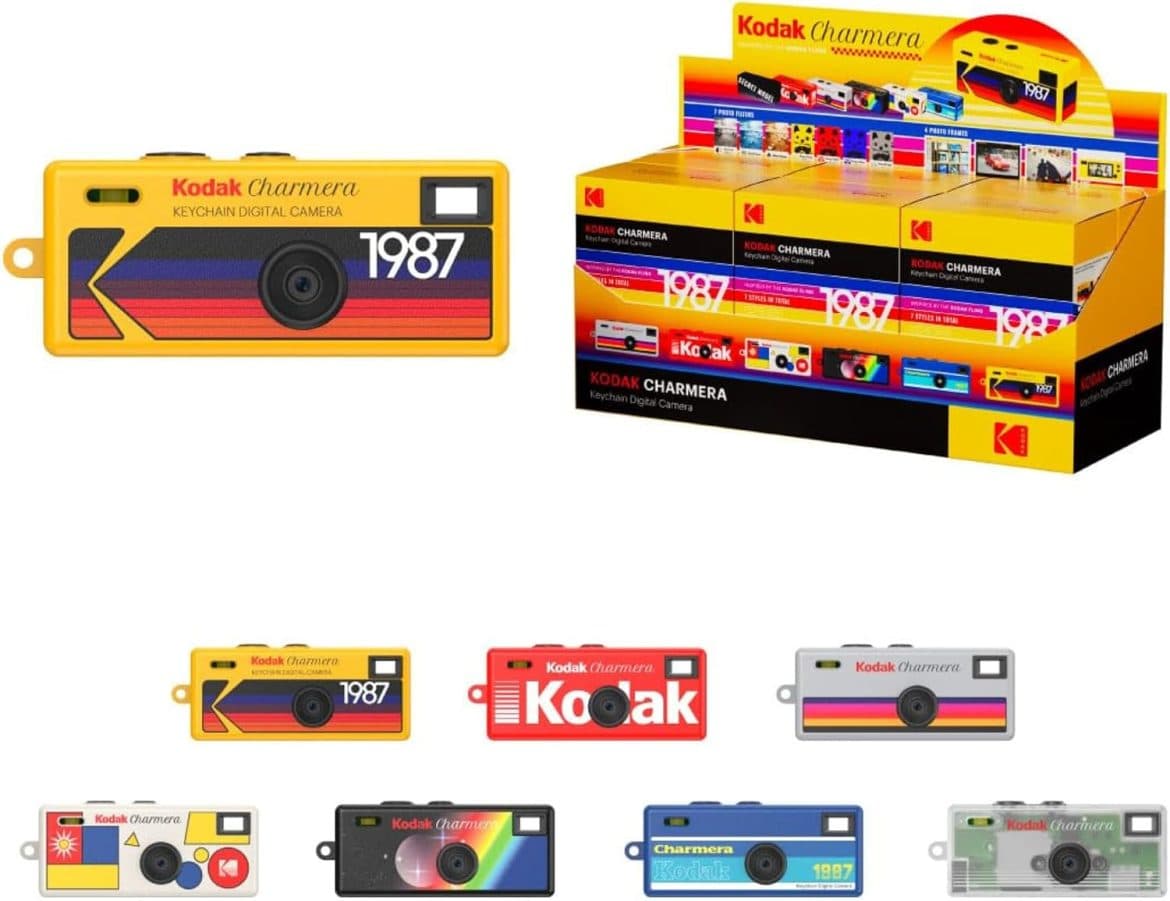
The camera is sold in blind-box packaging, with several different retro Kodak-inspired colourways available.
Kodak lists seven retro styles across the Charmera range, while the original release effectively offered several regular designs plus a rarer transparent version.
That makes them collectible in the same way as toys, figures and mystery-box products.
For some people, that is half the fun.
For others, paying around £35 for a camera and not being allowed to choose the colour will sound completely ridiculous.
Both reactions are reasonable.
You will need a microSD card
One important detail is easy to miss.
The Charmera does not have useful built-in storage for your photographs, so you need a microSD card.
It supports cards from around 1GB up to 128GB, according to published specifications.
That means there is a small additional cost if you do not already have one.
The microSD card slot sits on the bottom of the camera alongside the USB-C port.
There is also no serious weather protection, so this is something to keep away from rain despite the fact it is designed to hang from a bag or keychain.
Why has the Kodak Charmera gone viral?
Because it does the opposite of what cameras have spent the last 20 years trying to achieve.
Photography technology usually progresses towards cleaner images, higher resolution, better autofocus and increasingly sophisticated automatic processing.
The Charmera gives you none of that.
Instead, it gives you uncertainty.
You press the shutter and see what happens.
Recent photography coverage has specifically identified the Charmera as one of the products behind the growing lo-fi camera movement, where imperfect photographs are becoming desirable precisely because they do not look polished.
That is probably the best explanation for its popularity.
Your phone takes better pictures.
The Charmera takes more interestingly bad ones.
Is the Kodak Charmera actually made by Kodak?
There is a small distinction worth understanding.
The Charmera carries official Kodak branding, but it is produced under licence by Reto Production, the company also associated with products such as the Kodak Ektar H35 half-frame film camera.
Kodak’s own website lists the Charmera within its consumer digital camera range and notes that licensed products are developed by partner manufacturers.
That does not make it unofficial or counterfeit.
It simply means this particular Kodak-branded camera is manufactured by a licensee rather than by the same operation responsible for some other Kodak camera ranges.
Battery life is probably its biggest weakness
The Charmera uses a very small 200mAh rechargeable battery.
That is inevitable given its size, but it means battery performance is not one of its strengths.
In long-term hands-on testing, TechRadar specifically identified short battery life as one of the main drawbacks.
Fortunately, it charges through USB-C.
For a camera designed for occasional spontaneous photographs rather than an entire day of serious shooting, that limitation is easier to forgive.
But if you expect to use it continuously at a festival or on holiday, take a power bank.
Is it worth around £35?
That depends entirely on what you think you are buying.
If you want the best camera for £35, the Charmera is difficult to recommend.
Your smartphone is almost certainly better.
An older second-hand compact camera will probably produce technically superior photographs too.
But that misses the point.
You are buying something tiny, collectible, playful and deliberately imperfect.
It is a camera you can attach to your keys, forget about, then pull out because something funny happens.
There is no temptation to spend five minutes composing the perfect image or editing it afterwards.
That simplicity is surprisingly refreshing.
Who should buy the Kodak Charmera?
It makes the most sense for:
People who love retro tech. The entire product is designed around nostalgia.
Photography fans who already own good cameras. Oddly, experienced photographers may appreciate the Charmera precisely because it removes almost all control.
Teenagers and young adults who like the Y2K and early-digital aesthetic.
Anyone looking for an unusual gift. The blind-box element makes the unboxing part of the experience.
People who want photographs that look different from smartphone pictures.
It makes considerably less sense if you want reliable image quality, long battery life or a camera for important photographs.
GlitterBeam verdict
4 out of 5
The Kodak Charmera is objectively a terrible camera by modern technical standards.
That is also exactly why it works.
The 1.6MP photographs are soft and unpredictable. The screen is tiny. The battery is small. You need to provide your own microSD card, and you might not even get the colour you wanted.
Yet none of those things have stopped it becoming a viral success.
The Charmera turns taking photographs back into something casual and slightly unpredictable.
For around £35, it is less a replacement for your phone and more an antidote to it.
If that sounds appealing, you can see the current Kodak Charmera price on Amazon UK.