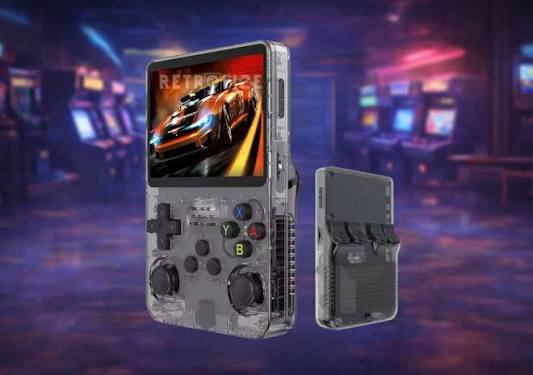
The R36S is a pocket-sized retro games console with the upright shape of a Game Boy and two analogue sticks beneath its buttons. On 25 November, TikTok Shop tracker ViralCatcher reported that one clip featuring a WUDS-branded R36S had gained 1.9 million views in 26 hours. If that video sent you looking for one, the most useful thing to know is that the R36S name appears on several versions of the handheld.
This R36S review draws on published hands-on testing, retailer information and community documentation. GlitterBeam has not tested a unit, and the specifications below describe the commonly reviewed configuration. Check the seller’s details for the exact version, storage and accessories before ordering. The Amazon UK listing linked below was priced at £54.99 on 25 November 2026.
R36S review: Screen, controls and hardware
The unit tested by Tech Tactician had a 3.5-inch IPS display with a resolution of 640 × 480, a Rockchip RK3326 processor and 1GB of RAM. It also had a directional pad, four face buttons, two clickable analogue sticks, four shoulder buttons and a 3.5mm headphone socket. Two microSD slots provided storage for the system and game files.
The 4:3 screen suits many home console games of the period. A small display makes sense for something you want to slip into a bag, and old pixel art can look at home at this size. Text-heavy games and titles designed for a widescreen display are a different proposition. If you mainly want larger text or plenty of space to see what is happening on screen, the portability comes with a clear trade-off.
The two sticks give you useful options for games that support analogue controls. For older platformers and puzzle games, the directional pad and face buttons will do most of the work. The shape is also worth considering if you tend to play for long stretches. On a narrow, upright device, the sticks sit low on the front, so a wider handheld may suit you better if analogue controls are how you usually play.
What games suit the R36S?
The R36S makes the strongest case for older 2D titles. Retro Game Corps’ hands-on review puts the RK3326 device through emulation tests, and T3’s coverage identifies systems such as the Super Nintendo, Mega Drive and original PlayStation as sensible targets. That gives it a clear use for short sessions with older platformers, arcade games and role-playing titles.
Expect more variation with demanding Nintendo 64, Dreamcast and PSP games. The community compatibility lists distinguish between systems and individual titles, which matters if you are buying for a particular game. Check reports for that game first. The fact that an emulator appears in a menu tells you little about how smoothly a specific title will run.
Listings can advertise thousands of games on a memory card. That figure says little about how useful the selection will be, and the presence of a title on a card does not establish that it is licensed. If you plan to build your own collection, budget for games you can legitimately use, including releases from homebrew developers.
Check the version and budget for storage
The main drawback is the variation between devices sold under the same name. Tech Tactician’s updated review distinguishes its tested unit from alternatives with different boards or display panels. The dArkOSRE project’s device list also records multiple hardware configurations. Check the seller’s stated chipset and storage, and keep the supplied system card intact if you plan to experiment with community software.
The memory card deserves attention even if you leave the software alone. The Handhelds Wiki documents reliability problems with some bundled cards and compatibility differences between slots. If you buy a replacement, check compatibility before ordering and budget for it alongside the console. Battery capacity also varies between listings, so treat runtime estimates for other versions as a guide at best.
Before buying, decide which systems you actually want to play and ask the seller to confirm anything the listing leaves ambiguous. Storage capacity is easy to compare, but the processor and the software it runs determine much more about the experience. A listing that explains what comes in the box, what the memory card holds and how to get support makes the purchase easier to assess.
If you are giving it as a present, allow time to check that it boots, charges and saves progress before wrapping it. Those are more useful first checks than working through a long list of games. If something fails on arrival, contact the seller before changing the system software.
Is the R36S worth the money?
PriceSpy listed a white 64GB R36S at £33.77 through Amazon Marketplace when we checked on 25 November 2026. That is £21.22 below the £54.99 price of the linked listing, although hardware and bundles can differ. Compare the exact configuration, delivery and returns before treating the lower price as an equivalent deal.
At roughly £30 to £40, the compact screen, dedicated controls and support for older systems make a good case for the R36S. At £54.99, the seller needs to justify the premium with clearer hardware details, a useful bundle or better support. Add the cost of a replacement memory card if you expect to need one.
Verdict: The R36S is a good budget option for older games, but at £54.99 we’d hold off unless the seller can confirm the hardware and explain what the bundle adds. The compact screen and dedicated controls are appealing. A lower-priced R36S with equivalent hardware would offer better value, and anyone buying mainly for more demanding 3D games should choose a more capable handheld.
Check the R36S listing on Amazon UK.