
Music · 16 September 2026
Ed Sheeran, Macklemore and the Loop Tour row: what actually happened, and what didn’t.
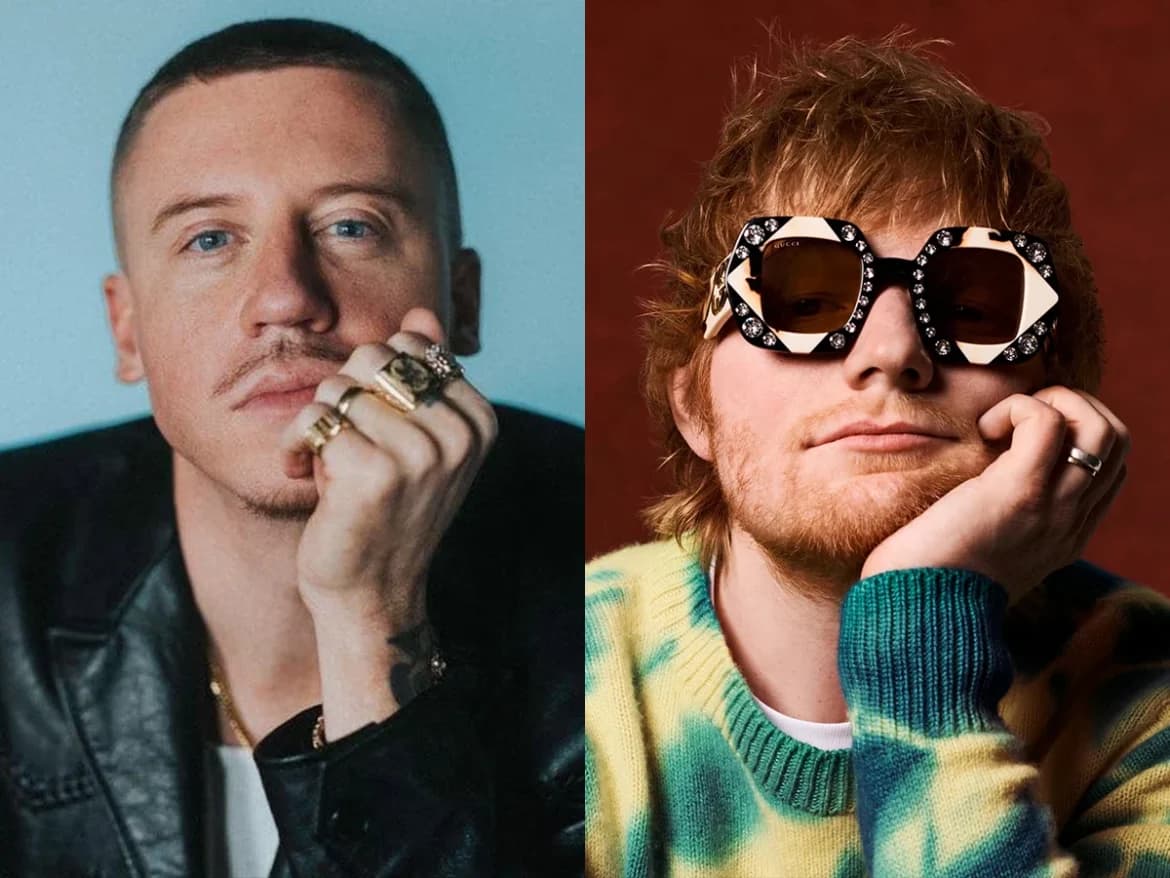
The fallout between Ed Sheeran’s Loop Tour and Macklemore has become one of the biggest music stories of the week, but it has also become a perfect example of how quickly a complicated story can be reduced to a few very confident claims online. “Ed Sheeran fired Macklemore for saying ...
The fallout between Ed Sheeran’s Loop Tour and Macklemore has become one of the biggest music stories of the week, but it has also become a perfect example of how quickly a complicated story can be reduced to a few very confident claims online.
“Ed Sheeran fired Macklemore for saying Free Palestine.”
“His PR team did it.”
“Macklemore is a proven antisemite.”
“Robert Kraft personally got him banned everywhere.”
“Ed chose money over Palestine.”
Some of those statements contain elements of the real story. Others go considerably further than the evidence currently allows.
So, here is what we can actually verify.
What happened at MetLife Stadium?
Macklemore appeared as a support act on Ed Sheeran’s Loop Tour at MetLife Stadium in New Jersey.
During the 4 September show, Macklemore made a short speech expressing support for Palestinians and said “Free Palestine” before performing his protest song Hind’s Hall. He returned the following night and again addressed the subject, including comments directed towards Jewish members of the audience in which he said his criticism of Israel was not criticism of Jewish people.
His performances prompted criticism from organisations including the Israeli-American Council and StopAntisemitism. The Israeli-American Council subsequently called for him to be removed from the tour.
That part is not disputed.
Did Ed Sheeran personally fire Macklemore?
There is currently no verified evidence that Ed Sheeran personally made the decision to remove Macklemore.
Messina Touring Group, the promoter responsible for the US leg of the Loop Tour, publicly said that venues hosting upcoming dates had told the promoter they would not allow their concerts to proceed with Macklemore on the bill. According to the promoter, that could have resulted in the cancellation of the affected shows, and Macklemore was therefore removed from his remaining support dates.
Sheeran subsequently addressed the controversy himself and said: “Macklemore coming off tour was the promoter’s decision, it was not mine.”
He said he had spoken with venues during the week in an attempt to find a solution, but that the decision of the venues and promoter was ultimately final.
That does not prevent people from criticising Sheeran for continuing with the tour. That is an opinion people are entitled to hold.
But “Ed Sheeran personally fired Macklemore” is not what the available evidence establishes.
Did Sheeran’s PR team make the decision?
We have found no credible source establishing this. The publicly identified decision-maker is Messina Touring Group following objections from venues. The promoter has itself confirmed the venue pressure. So describing the removal as a decision made by “Ed Sheeran’s PR team” should not currently be repeated as fact.
What was Robert Kraft’s involvement?
This part of the story is significant, but also needs some precision. Robert Kraft owns the New England Patriots and his Kraft Group owns Gillette Stadium, one of the venues scheduled to host Sheeran’s tour.
Macklemore claimed that Sheeran told him Kraft had refused to allow Macklemore to perform at Gillette Stadium and that Kraft had also rallied other stadium owners against his involvement.
Kraft subsequently confirmed that Gillette Stadium had decided Macklemore would not be allowed to participate in Sheeran’s shows there. In a statement to GBH News, Kraft cited Macklemore’s recent performances and what Kraft described as a broader history of antisemitic rhetoric and imagery.
Significantly, GBH reported that Kraft did not dispute Macklemore’s account of his involvement.
What has not been independently established in full is that Kraft personally caused every other venue to reject Macklemore. We know multiple venues objected because the tour promoter has confirmed it. Macklemore says Kraft helped coordinate that opposition. Kraft has confirmed his own intervention at Gillette. The precise discussions between every stadium owner have not been made public.
Is Macklemore’s antisemitism “well documented”?
This claim requires considerably more care. There is a documented controversy from 2014.
Macklemore appeared at an event wearing a dark wig and beard with a large prosthetic nose. Photographs prompted accusations that the disguise resembled an antisemitic Jewish caricature.
Macklemore denied that this had been his intention and apologised to anyone he had offended. The Anti-Defamation League, an organisation which campaigns against antisemitism, subsequently said it accepted Macklemore’s explanation that he had not intended to portray an antisemitic caricature and accepted his apology.
That incident is real. It is therefore accurate to say Macklemore has previously faced accusations over imagery considered antisemitic.
It is different, however, from stating as an uncontested fact that Macklemore has a proven history of antisemitism.
Robert Kraft and other critics currently characterise parts of Macklemore’s record that way. Macklemore rejects that characterisation and argues that criticism of Israel should not be conflated with hostility towards Jewish people. Those are competing positions and should be reported as such.
Was Macklemore a headliner on Sheeran’s tour?
No. Macklemore was appearing as a support or opening act for Ed Sheeran. He had been scheduled to appear at eight of the ten remaining US stadium dates.
It sounds like a small distinction, but it matters when explaining who controlled the tour and the relationship between the artists.
Did Ed Sheeran “choose money over Palestine”?
That is an interpretation, not a verifiable fact. Sheeran has explained his decision to continue the tour in terms of commitments to ticket holders, touring staff, musicians and other people whose livelihoods depend upon the shows going ahead.
He has also said that although he has personal views on the conflict, he generally chooses not to turn his concerts into political forums and instead wants his shows to bring together audiences from different backgrounds.
Critics are entitled to believe that he should have cancelled concerts rather than continue without Macklemore.
Others are entitled to believe continuing the shows was reasonable.
What cannot be established from the available evidence is somebody’s internal motivation. Saying Sheeran “chose money” states a motive as fact when it is actually a judgment about his decision.
And what about Pink?
Pink, who is Jewish, was among those who expressed concern following Macklemore’s performance.
But another simplification has developed around her position.
Pink specifically clarified that she was not objecting simply to the words “Free Palestine”, nor was she demanding that Macklemore be fired. She said she was concerned about aspects of what was presented at the concert and about how Jewish audience members felt in that environment.
Again, that distinction matters.
Did the other artists really walk out?
Yes.
After Macklemore was removed and Sheeran issued his explanation, Finneas, Aaron Rowe, Lukas Graham and Irish band Beoga announced that they were withdrawing from scheduled appearances connected with the tour.
Their statements expressed support for Palestinians, Macklemore or the principle that artists should be able to speak publicly about the issue.
That is not social-media speculation. It happened.
So what actually happened?
Strip away the arguments and the verified sequence is considerably clearer.
Macklemore used his appearances on Ed Sheeran’s tour to make explicitly pro-Palestinian statements.
His performance generated objections from organisations and venue operators.
Robert Kraft confirmed that Gillette Stadium would not host Macklemore and defended that decision by citing what he regarded as offensive material and a wider history of concern.
Other venues also told tour promoter Messina Touring Group that they would not allow concerts to proceed with Macklemore on the lineup.
Messina Touring Group removed Macklemore from the remaining dates.
Sheeran says he tried unsuccessfully to broker a solution and says removing Macklemore was not his decision.
Macklemore fundamentally disagrees with Sheeran’s approach to remaining publicly apolitical, while saying the disagreement does not erase their personal relationship.
And several other artists have now withdrawn from the tour in response.
Those facts leave plenty of room for legitimate disagreement about artistic freedom, political speech, antisemitism, responsibility, venue ownership and whether famous musicians should use their platforms to address international conflicts.
But those discussions are better served when the starting facts are correct.